
A therapy session is unique. It's a private and safe space where you can share anything and everything with your therapist. There's no holding back. What you say is not leaving the room.
Slowly but aggressively, some mental health tech companies are chipping away at this privacy of therapy sessions, under the guise of efficiency.
It used to be a big deal to record therapy sessions. This is why it has separate callouts in various codes of ethics... for decades. It was meant for very specific circumstances, like training and supervision, not for documentation efficiency. And this was back in the day of closed-circuit televisions and cassette tape recorders.
It's still a big deal today to record therapy sessions. And now, that audio is not staying within the room or the building. It's sent to a server. It's transcribed to text. It's interpreted and processed by AI. So today's "recording" has far more complexities than yesterday's cassette tape "recording".
But many of these tech companies? They don't call it "recording". They call it "transcription". Or "ambient listening". Or even simply "AI" or "data processing".
That's not fair to the clients who are sharing their deepest and most private thoughts. And it's not fair to the therapists themselves, who are ultimately tasked with asking for their client's informed consent, when they themselves are not getting all of the information.
If cassette tapes were a big deal, this should be a big deal too.
And so therapists and clients alike need to be informed. You can say no to recording therapy sessions. You can say no to an "AI scribe" or "transcribing" or "ambient listening" in your session.
If you're a client, you have the right to decline. And at any time, you can explicitly ask your therapist: Are you recording or using transcription or AI during this session? You can retract any previous consent.
If you're a therapist, you're not alone in having reservations about introducing this technology into your therapy session. We've talked to hundreds and hundreds of therapists who agree with you.
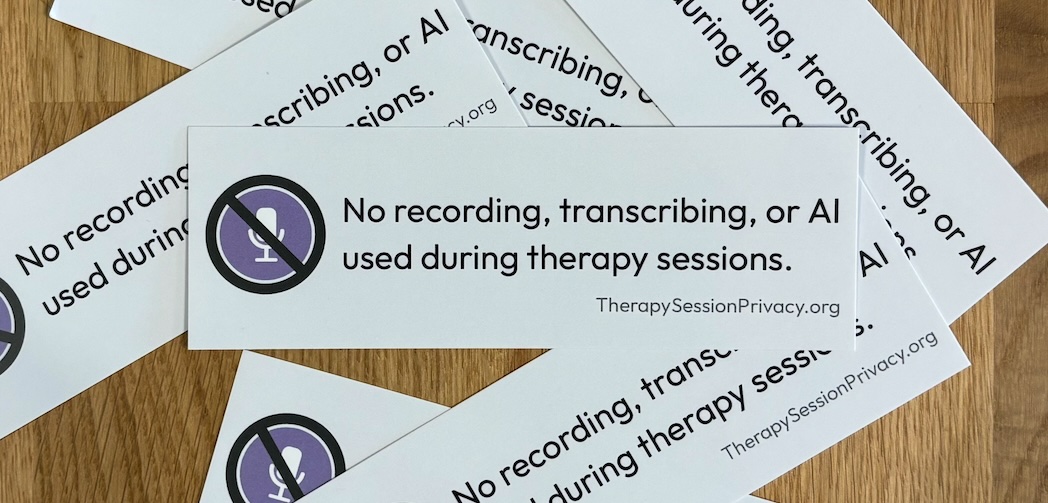
As pictured above, we started handing out these little signs at the ACA conference last month. Something that therapists can put on display to reassure their clients.
It's time for transparency. Not just for the mental health tech companies who are hiding behind vague and confusing terminology. But also for therapists who are choosing to continue the long-held standard of not recording their therapy sessions. In the months and years to come, your commitment to privacy will be a differentiator. Truly, clients will seek you out.
If you want to know more, there's now a separate website, TherapySessionPrivacy.org. We've got a section for therapists and a section for clients, detailing the reasons why you should not record therapy sessions.
This is not a controversial take. Or at least it shouldn't be.
Many thanks to all of the folks who have already contributed their perspectives on this topic. You can view them by clicking the "Perspectives" link when you visit TherapySessionPrivacy.org. If you want to share your own perspective, we'd love to feature it there as well!